
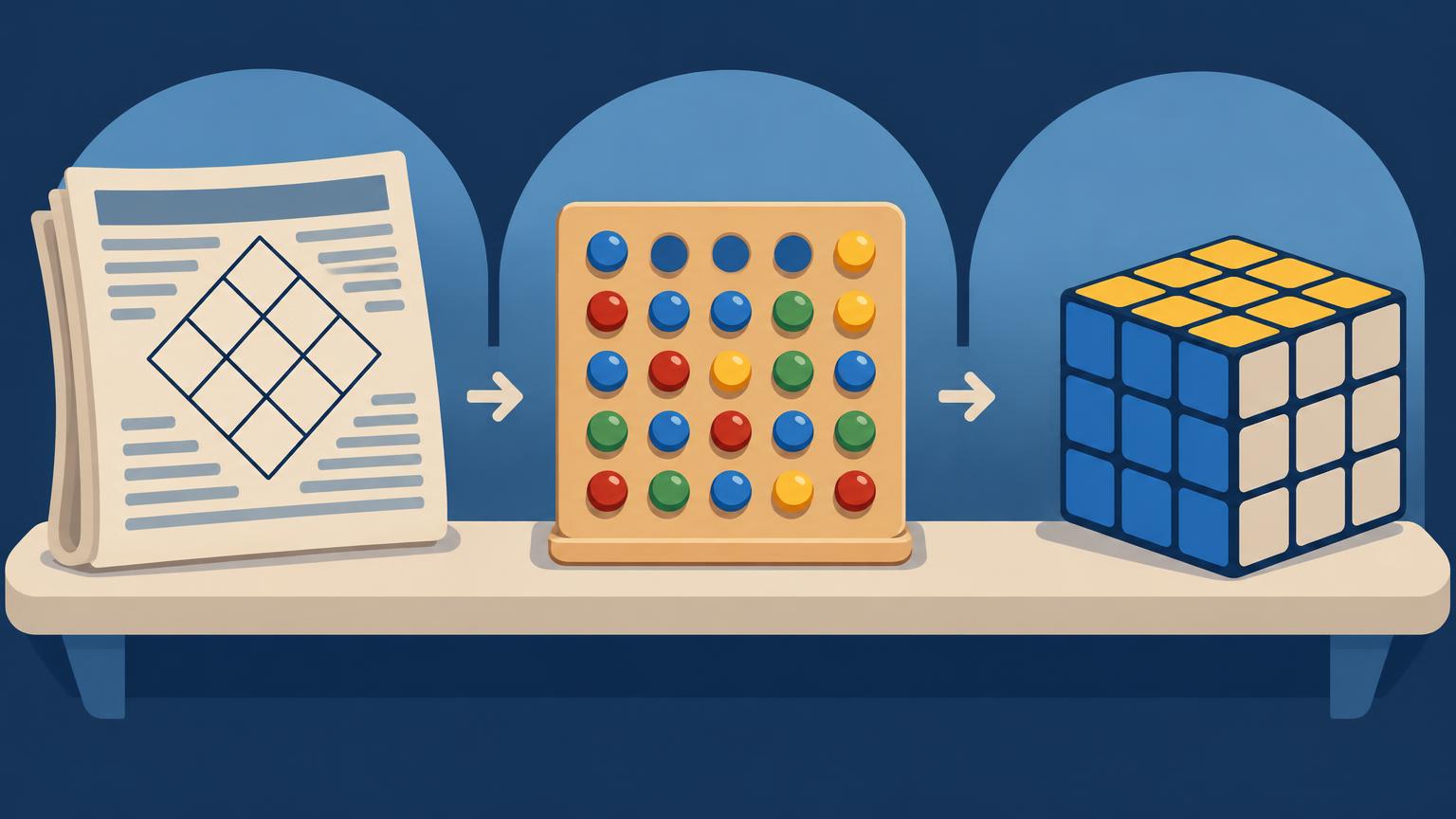
1913: a newspaper wants something new
Arthur Wynne ran “Fun”, the jokes and puzzles supplement of the New York World. In 1913 he was laying out the Christmas edition and felt readers needed a new challenge. He drew a diamond-shaped grid with an empty centre, put the word FUN at the top as the first answer, and called it a “Word-Cross”. One clue asked for what the puzzle was. The answer was “hard”. An illustrator later mixed up the name, “Cross-Word” stuck, and Wynne did not object.[1]
1924: a craze, and a lot of grumbling
In 1924 two new publishers, Richard Simon and Lincoln Schuster, printed the first book of crosswords because Simon’s puzzle-loving aunt asked them to. They threw in a pencil. They were so unsure of the book that their firm’s name stayed off the cover, and they printed 3,600 copies. It went on to sell more than 100,000.[1]
Their firm also set up the Amateur Cross Word Puzzle League of America, which began to standardise the grids. No part of the grid could be cut off by black squares, only one-sixth of the squares could be black, and the pattern had to be symmetrical. There was even a 1924 song called “Cross-word Mamma You Puzzle Me (But Papa’s Gonna Figure You Out)”.[1]
The Times of London ran an editorial called “An Enslaved America”, and librarians complained about crossword fans crowding the reference desk. The New York Times called crosswords “a primitive sort of mental exercise” that same year.[1] It ran its own first one in February 1942. An editor had argued, in a memo written two weeks after the US joined the war, that readers would need something to do through the blackout hours.[1]
1943: a pianist and a murder
Anthony Pratt, a pianist who worked in European hotels, and his wife Elva designed Clue in 1943, based on the murder-mystery games guests played at those hotels. It was patented in 1947 and then held up for years by post-war shortages. Waddington’s in London published it as Cluedo in 1949, and Parker Brothers brought out Clue in the US the same year.[2]
The museum says other murder games came before it, but none combined its simple play with the fun of working out who, where and with what.[2]
1970: a postmaster and four colours
Mordecai Meirowitz, an Israeli postmaster and telecommunications expert, invented Mastermind in 1970. MathWorld says it may have been inspired by “moo”, a computer program written at MIT in the late 1960s.[3]
1974: a teacher and a cube
Erno Rubik, a Hungarian design teacher, assembled his first cube in 1974 and called it the Magic Cube. A toy agent pitched it to the Ideal Toy and Novelty Company, which renamed it and began selling it in 1980. Within two years people had bought 100 million.[4]
The first story the media told was that Rubik made it to teach students about three-dimensional objects. Rubik later said he had set out to design a puzzle based on geometry. His key idea was to hinge the little blocks on a rounded core, so they could move freely and still hold the shape of a cube.[4]
The cube led to hundreds of spin-offs, from bestselling books on how to solve it to look-alikes that infringed its patent. It even gave people medical problems. The museum names “cube’s thumb” and “Rubik’s wrist”, and says support groups sprang up in the 1980s to help people kick the habit.[4]